

welcome to my world :)
Mothers of the Machine
A visual series on the women who shaped computing, from Ada Lovelace to Fei-Fei Li. Written and designed by me.
Part 1: Ada Lovelace
Read this page
At seventeen, Ada Lovelace asked her mother to find out everything she could about anything “curious, mysterious, marvellous, electrical.” That hunger seems to be the best way into her mind.
Ada studied mathematics seriously, but she was never interested in mathematics as a closed world. She wanted to connect it to music, machinery, language, imagination and the nature of thought itself.
She called herself an “Analyst (& Metaphysician)” and described her way of thinking as poetical science: imagination and rigorous analysis working together rather than apart.
When Charles Babbage showed her his calculating machinery, she did not only ask how it worked. She began asking what a machine like it could become.
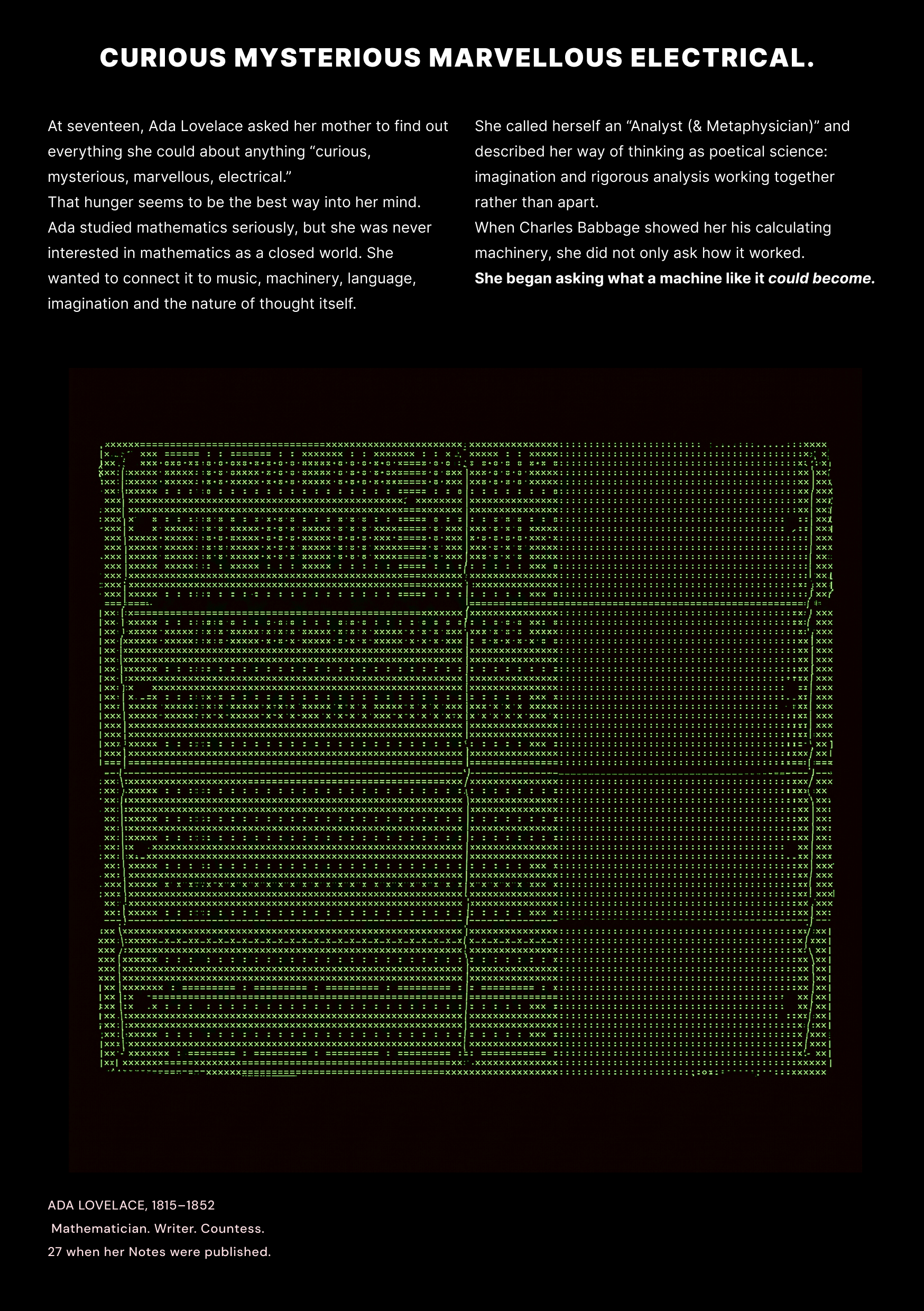
Ada Lovelace, 1815–1852. Mathematician. Writer. Countess. 27 when her Notes were published.
Read this page
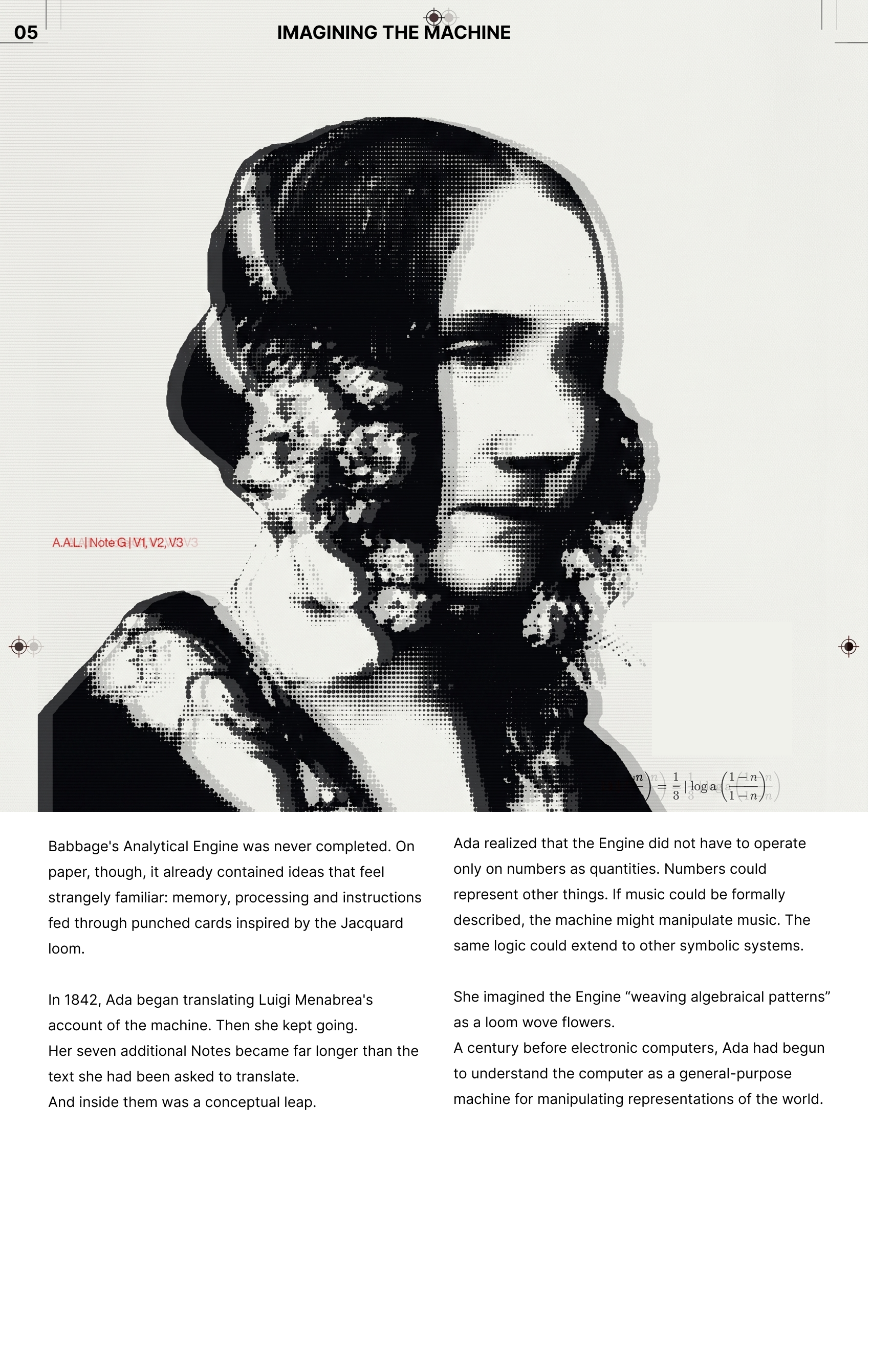
Babbage’s Analytical Engine was never completed. On paper, though, it already contained ideas that feel strangely familiar: memory, processing and instructions fed through punched cards inspired by the Jacquard loom.
In 1842, Ada began translating Luigi Menabrea’s account of the machine. Then she kept going. Her seven additional Notes became far longer than the text she had been asked to translate. And inside them was a conceptual leap.
Ada realized that the Engine did not have to operate only on numbers as quantities. Numbers could represent other things. If music could be formally described, the machine might manipulate music. The same logic could extend to other symbolic systems.
She imagined the Engine “weaving algebraical patterns” as a loom wove flowers.
A century before electronic computers, Ada had begun to understand the computer as a general-purpose machine for manipulating representations of the world.
Read this page
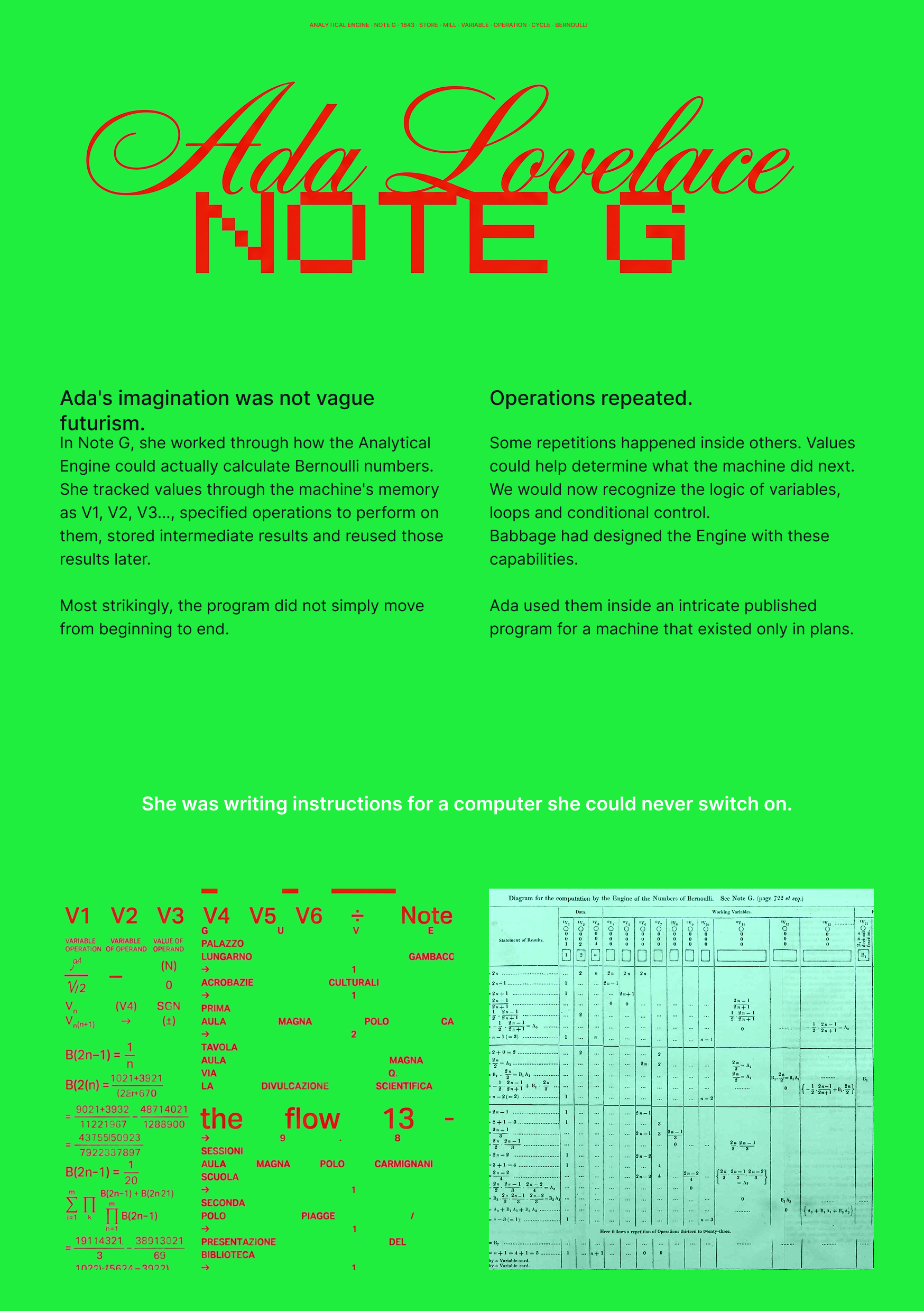
Ada’s imagination was not vague futurism.
In Note G, she worked through how the Analytical Engine could actually calculate Bernoulli numbers. She tracked values through the machine’s memory as V1, V2, V3…, specified operations to perform on them, stored intermediate results and reused those results later.
Most strikingly, the program did not simply move from beginning to end.
Operations repeated. Some repetitions happened inside others. Values could help determine what the machine did next. We would now recognize the logic of variables, loops and conditional control. Babbage had designed the Engine with these capabilities.
Ada used them inside an intricate published program for a machine that existed only in plans.
She was writing instructions for a computer she could never switch on.